

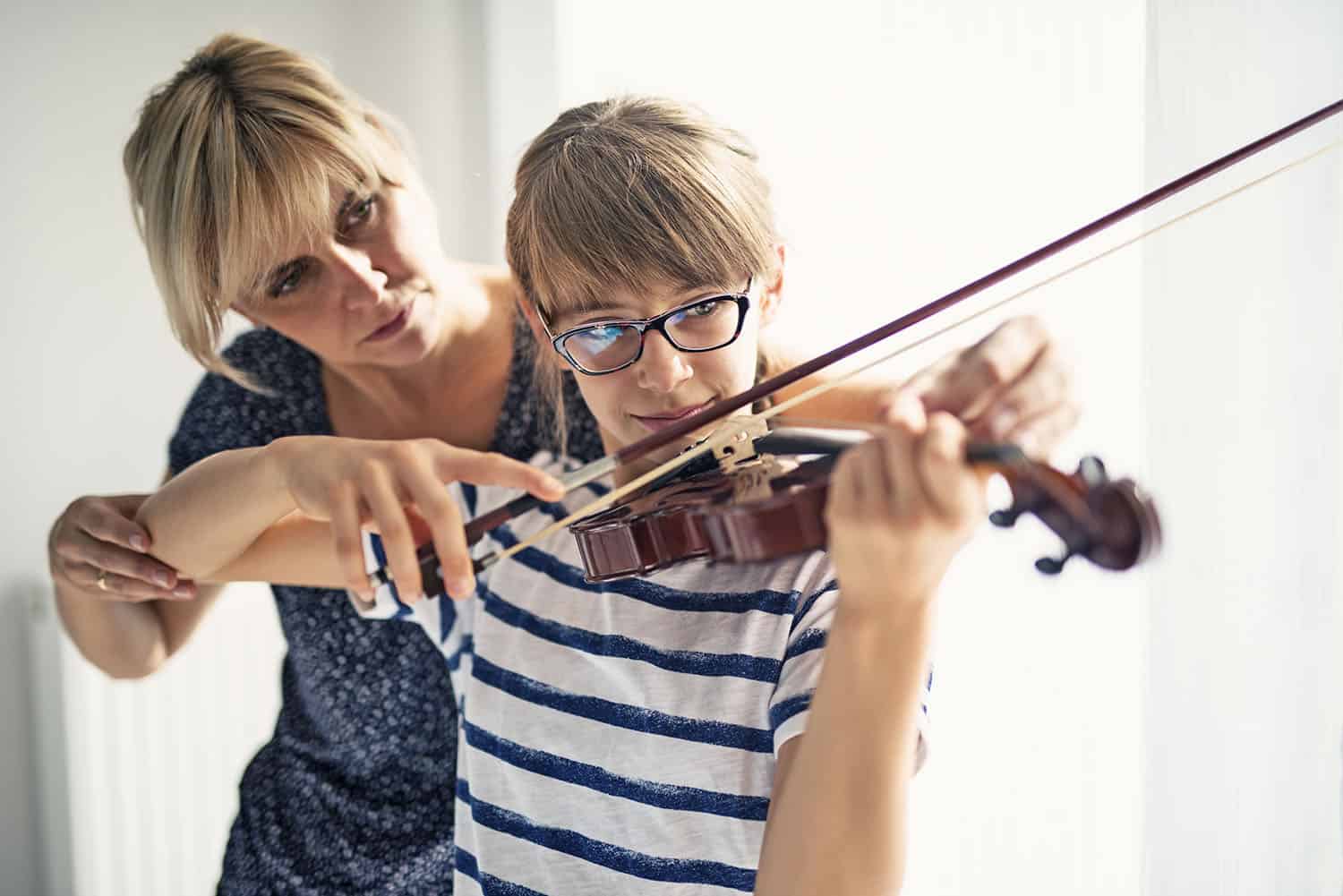
Violins come in several fractional sizes so children can learn with an instrument that fits their bodies. Choosing the correct size matters because a violin that is too large can make posture, bowing and finger placement unnecessarily difficult.
The short answer: A child’s violin size should be selected according to arm length, reach and comfort—not age alone. A teacher or violin specialist should confirm the fit before a family rents or buys an instrument.
What do fractional violin sizes mean?
Common student sizes include 1/16, 1/10, 1/8, 1/4, 1/2, 3/4 and full size, which is written as 4/4. These labels identify general instrument sizes; they are not exact mathematical proportions.
Children move through sizes as they grow. This is one reason rental programs are often appealing for young beginners.
Why age charts are only a starting point
Two children of the same age can have different arm lengths and hand sizes. An age-based violin chart may help narrow the possibilities, but it should not be the final decision.
The student must be able to hold the violin without straining, support a comfortable left-hand position and reach the appropriate area of the instrument.
How is a child measured for a violin?
A common measurement begins at the base of the neck and follows the extended arm to the centre of the palm or wrist, depending on the sizing method used by the teacher or retailer.
Because methods and instrument models can vary, families should not rely only on a home measurement. Use it to estimate a size, then ask a qualified person to check the student’s posture and reach with the actual violin.
What happens if a violin is too large?
An oversized violin may cause the student to reach, twist or tense the shoulder and hand. This can make early technique harder and practise less enjoyable. Buying a larger instrument “to grow into” may save a future exchange but can interfere with learning now.
A slightly smaller, comfortable violin is usually preferable to one the child cannot hold correctly.
What else does a beginner need?
A beginner setup normally includes a bow, case and rosin. Depending on the student, the teacher may also recommend a shoulder rest or other support. Instrument quality and setup matter: strings, bridge position, pegs and bow condition all affect usability.
Ask for guidance before adding accessories. The most expensive option is not necessarily the most suitable.
Frequently asked questions
Can I determine violin size from my child’s age?
Age can provide a rough estimate, but arm length, hand size and comfort are more reliable. Confirm the size in person whenever possible.
Is a full-size violin suitable for a child?
It depends on the child’s reach. Many students use fractional sizes before moving to a full-size violin.
Should I buy a violin that my child can grow into?
Usually not. An oversized violin can encourage uncomfortable posture and make technique more difficult.
How often should violin size be checked?
Check periodically during growth and whenever the instrument begins to look cramped or the teacher notices a change in posture.
Should a beginner rent or buy a violin?
Both are possible. Rental can make size changes easier, while buying may make sense when the size and commitment are established.
Violin lessons in Winnipeg
A properly fitted violin helps make the first stages of learning more comfortable. Explore our violin lessons in Winnipeg or learn about the convenience of in-home music lessons. Ready to get started? Register for violin lessons with Academy of Music.